

Che-Wei Wang / Kristin O'Friel
Lasercut Masonite, Servo Motors, Vibration Motor, GPS, Digital Compass, Microcontroller, Crocheted Wool
(2007)
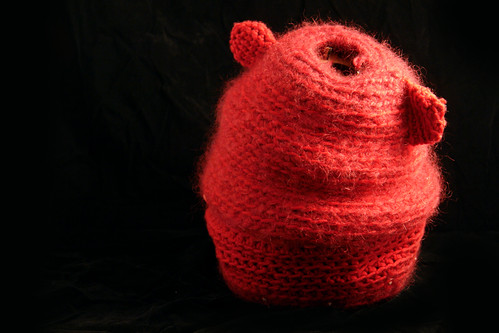
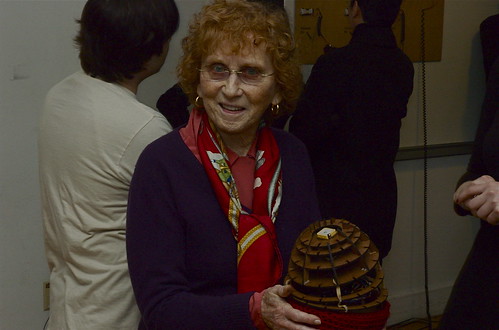
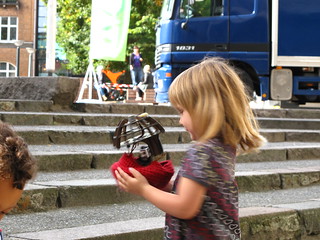
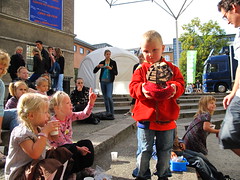
Momo is a haptic navigational device that requires only the sense of touch to guide a user. No maps, no text, no arrows, no lights. It sits on the palm of one's hand and leans, vibrates and gravitates towards a preset location. Akin to someone pointing you in the right direction, there is no need to find your map, you simply follow as the device leans toward your destination.
Momo is twelve inches tall, it has an eight inch diameter and weighs approximately one pound.
The possible user scenarios that can come out of this device range from treasure hunts to assistive technology for the forgetful. We currently have preprogrammed GPS coordinates of twelve NYC parks and use Momo as a tour guide. Detached from the map users are free to experience the city as they move with ease from one destination to the next at their own leisurely pace.
Momo developed out of a desire to create a non-visual form of navigation. We wanted to create a mechanism to guide a user that relied exclusively on the sense of touch.
Circumventing the map, Momo provides positive emotional experiences, enabling people to feel empowered in unfamiliar spaces. Visitors and residents alike can find themselves at play, discover new places, share secrets and meet each other as they move through the city with momo.
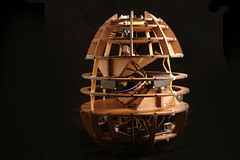
Momo is comprised of a GPS module, digital compass, an arduino board, two servo motors and a vibration motor.
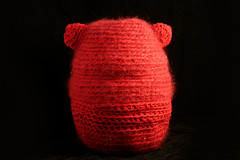
Momo's armature was 3-D modeled and laser cut out of masonite. The structure has a flexible mid-section to accommodate 360-degrees of rotation made possible using two centrally located servo motors. Using your current position and your relation to North the microcontroller calculates the angle to your destination and controls the motor's movement to point you in the right direction. Momo's sweater was crocheted out of wool, cotton, and love, creating a soft, huggable surface.
Press
New York Times, Toys Using Technology in Novel Ways
nymag.com, MoMo Isn't Exactly the New Seeing-Eye Dog, But He Sure Is Cute
New York Times, Object-Oriented Objects at N.Y.U.
Makezine, ITP Winter show — highlights and video!
Exhibitions
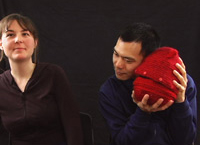
Kristin O'Friel is an artist and designer from Hawaii currently residing in New York City. As an artist Kristin is interested in creating interactions that engage public space and cognitive frameworks through interventions in the urban experience. She practices common sense, garnering inspiration and insight through everyday interactions. Kristin received her Masters from ITP, NYU. kristin.ofriel@nyu.edu
Che-Wei Wang [pron. say-way] was born in Tokyo, Japan to a Taiwanese mother and a Japanese / Taiwanese father. He is a visiting instructor at the Pratt Institute School of Architecture. He has taught parametric modeling, advanced media, technics, design studios and various scripting workshops at Pratt Institute, University at Buffalo, Columbia University, University of Pennsylvania and City College of New York. Che-Wei is the winner of the 2003 SOM fellowship and the Young Alumni Achievement Award from Pratt Institute. He holds a B.Arch from Pratt Institute and a MPS from NYU (TISCH ITP). cwwang@gmail.com
Created with support from 
Developed at the Interactive Telecommunications Program, NYU